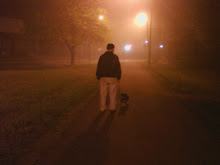
Not long ago I read the following poem in Mary Oliver’s most recent book Red Bird.
We Should Be Well Prepared
The way the plovers cry goodbye.
The way the dead fox keeps on looking down the hill
with open eye.
The way the leaves fall, and then there’s the long wait.
The way someone says: we must never meet again.
The way mold spots the cake,
the way sourness overtakes the cream.
The way the river water rushes by, never to return.
The way the days go by, never to return.
The way somebody comes back, but only in a dream.
On December 20 I found out my father has inoperable liver cancer and has only weeks or months to live.
With Faith and With Feathers,
David
Saturday, January 3, 2009

Friday, December 19, 2008
Merry Christmas

This is Henry Ossawa Tanner’s 1898 painting “The Annunciation.” Tanner was the son of an African Methodist Episcopal minister.
I will be devoting my creative energies toward the celebration of Christmas at my church (and if you are reading this and looking for a place to worship, join us Christmas Eve at 4 p.m. or 10 p.m.), so will take a brief break from blogging. May you find joy and peace at Christmas.
With Faith and With Feathers,
David
Saturday, December 13, 2008
My wife Julie and my two daughters really enjoy Christmas music. Julie looks forward to November 1 each year, because that’s when she begins playing the music of the season – in her car driving to and from work, in our home when we have music on. Last year, I put together a CD of Christmas music that I especially enjoy (and wrote about it in this blog). One CD does not a season of Christmas music make, so this year I burned another. Last year I tried to have a diverse group of songs that I enjoy. This year I used only music from a few of my favorite Christmas CDs – CDs by Louis Armstrong, Chicago, Vince Guaraldi, Diana Krall, Sarah McLachlan, and James Taylor. I purposely burned multiple versions of some of the same songs because I like the song so well and it is often interesting to hear how different artists render the same song. It reminds me that music, like the Scriptures which contain the Christmas story, can be interpreted differently and we are enriched by hearing differing views. Emily Dickinson: Tell all the Truth but tell it slant (poem 1129).
So here is my “new” Christmas CD, with commentary.
What Child is This, Vince Guaraldi Trio: I love this tune (Greensleeves), and I love Vince Guaraldi’s work on the Charlie Brown Christmas CD. It is one of my favorite Christmas CDs, and the Charlie Brown Christmas Special is also a favorite.
What Child is This, Sarah McLachlan: This rendition of the song is marvelous. Sarah McLachlan’s voice is splendid.
Winter Wonderland, Chicago: The song is o.k., but the arrangement is what does it for me. Chicago has been a favorite band for a long time. Maybe listening to this band reminds me of younger days. Chicago was one of “the bands” when I was in high school.
Christmas Time Is Here, Vince Guaraldi Trio – instrumental: As you will see as we go on, this is one of my absolute favorite Christmas songs. There is a peacefulness, a quiet joy and a tinge of wistfulness. All of those are a part of Christmas for me. The song invites a reflectiveness – “but Mary treasured all these words and pondered them in her heart” (Luke 2:19). Yes, this is a secular song, but The Charlie Brown Christmas special has the gospel story at its heart. The message of Christmas is one that blurs “sacred” and “secular” anyway. God comes near, touches human life and history in the person Jesus. God will be found in the midst of life, incarnate in unlikely places.
Have Yourself a Merry Little Christmas, James Taylor: Here is another quiet song filled with simple joy and wistfulness. There are troubles aplenty, but we may wish each other the simple joys of this time of year. We may wish for others lighter hearts in a world that often makes our hearts heavy.
I’ll Be Home for Chirstmas, Diana Krall: Yet another song with a decidedly wistful feeling. It, too, celebrates simple Christmas joy, even when that may have to be experienced from a distance. I guess, for me, Christmas joy is quiet joy, and a delight in simple pleasures. There is a place for a more raucous celebration, to be sure. However, a sense of peacefulness is important for me. I also want a celebration of Christmas that acknowledges that the world has not yet grasped the peace and goodwill proclaimed in the story – we still yearn for a better world.
Christmas Time is Here, Sarah McLachlan: Beautiful voice, and wonderful song. If you don’t like this song, you would not like this CD. There are more versions to come.
White Christmas, Louis Armstrong: When I hear Louis Armstrong, I smile. His music brings joy. I have the faintest memories of seeing him on variety shows when I was a kid. I think I remember thinking this person with the gravelly voice was certainly unique. I wasn’t sure whether I liked it or not. All doubt has been removed.
Christmas Time is Here, Chicago: Here it is again, and the Chicago treatment of it is very nice.
I’ll Be Home for Christmas, Sarah McLachlan: Sarah McLachlan’s Wintersong may be my second favorite Christmas CD after the Guaraldi CD. Every song on it is worth listening to. She renders this one with beauty and feeling.
Christmas Time is Here, Diana Krall: Diana Krall is an exceptional jazz singer, and she offers another worthy version of this tune.
River, James Taylor: This Joni Mitchell tune is not technically a Christmas song, just set in the Christmas season. It found its way onto both James Taylor’s and Sarah McLachlan’s Christmas CDs (and on to this one). The song is about the desire to get away from things for awhile, something we might all feel now and again. To touch that sadness inside can lead us make changes in our lives and our world. At least that’s what it does at its best.
Christmas Time is Here, Vince Guaraldi – choir version: One final rendition, Guaraldi joined by a children’s choir.
Have Yourself a Merry Little Christmas, Diana Krall: O.k. I have a high tolerance for listening more than once to songs I like.
River, Sarah McLachlan: Ditto. McLachlan sings this beautifully. I really feel the song.
Christmas Night in Harlem, Louis Armstrong: This CD has a lot of reflective songs filled with quiet joy and wistfulness. It is good to have one that swings and who better to swing with than Louis Armstrong.
Baby It’s Cold Outside, James Taylor and Natalie Cole: From sheer joy to a plea for romance. It’s cold outside, so why don’t you stay a little longer. A little light entertainment is a good thing.
In the Bleak Midwinter, James Taylor: This is another favorite “sacred” Christmas song. It acknowledges a difficult world and invites us to give our hearts to one who will inspire us make a difference.
In the Bleak Midwinter, Sarah McLachlan: One good version deserves another.
Silent Night, Sarah McLachlan: Christmas does break down the sacred/secular divide in many ways. In American society, however, where we are willing to risk losing the sacred dimension entirely in the hustle and bustle and buying frenzy, I find it good to listen to the explicitly sacred songs celebrating the birth of Jesus. Again, Sarah McLachlan offers a stirring version of a familiar song.
So that’s what I am listening to this Christmas season. I hope you are finding music to touch the heart and stir the soul.
With Faith and With Feathers,
David
Christmas Time is Here from The Charlie Brown Christmas Special
Wednesday, December 10, 2008

Today is Emily Dickinson's birthday. I could not let it go by without a word of celebration.
Click on the link to the Writer's Almanac to hear a little bit about Emily Dickinson and about William Faulkner's Nobel Prize speech.
With Faith and With Feathers,
David

William Faulkner’s Nobel Prize Acceptance Speech
I feel that this award was not made to me as a man, but to my work - a life's work in the agony and sweat of the human spirit, not for glory and least of all for profit, but to create out of the materials of the human spirit something which did not exist before. So this award is only mine in trust. It will not be difficult to find a dedication for the money part of it commensurate with the purpose and significance of its origin. But I would like to do the same with the acclaim too, by using this moment as a pinnacle from which I might be listened to by the young men and women already dedicated to the same anguish and travail, among whom is already that one who will some day stand here where I am standing.
Our tragedy today is a general and universal physical fear so long sustained by now that we can even bear it. There are no longer problems of the spirit. There is only the question: When will I be blown up? Because of this, the young man or woman writing today has forgotten the problems of the human heart in conflict with itself which alone can make good writing because only that is worth writing about, worth the agony and the sweat.
He must learn them again. He must teach himself that the basest of all things is to be afraid; and, teaching himself that, forget it forever, leaving no room in his workshop for anything but the old verities and truths of the heart, the old universal truths lacking which any story is ephemeral and doomed - love and honor and pity and pride and compassion and sacrifice. Until he does so, he labors under a curse. He writes not of love but of lust, of defeats in which nobody loses anything of value, of victories without hope and, worst of all, without pity or compassion. His griefs grieve on no universal bones, leaving no scars. He writes not of the heart but of the glands.
Until he relearns these things, he will write as though he stood among and watched the end of man. I decline to accept the end of man. It is easy enough to say that man is immortal simply because he will endure: that when the last dingdong of doom has clanged and faded from the last worthless rock hanging tideless in the last red and dying evening, that even then there will still be one more sound: that of his puny inexhaustible voice, still talking. I refuse to accept this. I believe that man will not merely endure: he will prevail. He is immortal, not because he alone among creatures has an inexhaustible voice, but because he has a soul, a spirit capable of compassion and sacrifice and endurance. The poet's, the writer's, duty is to write about these things. It is his privilege to help man endure by lifting his heart, by reminding him of the courage and honor and hope and pride and compassion and pity and sacrifice which have been the glory of his past. The poet's voice need not merely be the record of man, it can be one of the props, the pillars to help him endure and prevail.
Friday, December 5, 2008
There are a number of female poets whose works are among my favorites. I mention Emily Dickinson in my profile. Her poem – “Much madness is divinest sense” was one of the first poems I memorized. I read it first not in a book, but on a paper bag given by a book store on the West Bank of the University of Minnesota – Savran’s Paperback Shop, if memory serves me. The name of this blog is inspired by her poem, “hope is the thing with feathers/that perches in the soul.” Last blog I cited a poem by Lisel Mueller. Jane Kenyon is another favorite. I also love the poetry of Mary Oliver, and in this I am not alone. Mary Oliver may be the best-selling poet currently writing. Her most recent book is Red Bird, and I have been reading a poem a day from it (most days, anyway).
Here is a poem from the book that displays a wonderful combination of thoughtfulness and humor. Only because it is brief does quoting it in its entirety make sense. I encourage you to buy a copy of Red Bird and enjoy its full contents.
Watching a Documentary about Polar Bears Trying to Survive on the Melting Ice Floes
That God had a plan, I do not doubt.
But what if His plan was, that we would do better?
One might offer lengthy theological commentary. I will refrain from that. I will only say that I would prefer God not necessarily be a male pronoun and that whatever God’s original intent, it is clear to me that God is also a God of second chances (though we humans may exhaust those chances here on planet earth if we don’t take better care of it and of each other).
With Faith and With Feathers,
David
Tuesday, November 25, 2008
It is Thanksgiving Thursday, one of my favorite holidays of the year – a favorite because it gives me ample opportunity to spend time with my family and comes with fewer demands on my time as a pastor. This year, for the first time in many, all three of our children will be together at our house for dinner.
The following poem – filled with subtle humor and deep gratitude – is also one of my favorites. It moves me to deep thankfulness and I offer it hoping that it might do the same for you. Because I located it in its entirety on “poem hunter,” I offer it here (I want to be faithful to the creative work of authors and the copyright laws which try and protect that creativity. The book from which it comes was awarded the Pulitzer Prize for poetry in 1996.
Alive Together Lisel Mueller (b. 1924)
Speaking of marvels, I am alive
together with you, when I might have been
alive with anyone under the sun,
when I might have been Abelard's woman
or the whore of a Renaissance pope
or a peasant wife with not enough food
and not enough love, with my children
dead of the plague. I might have slept
in an alcove next to the man
with the golden nose, who poked it
into the business of stars,
or sewn a starry flag
for a general with wooden teeth.
I might have been the exemplary Pocahontas
or a woman without a name
weeping in Master's bed
for my husband, exchanged for a mule,
my daughter, lost in a drunken bet.
I might have been stretched on a totem pole
to appease a vindictive god
or left, a useless girl-child,
to die on a cliff. I like to think
I might have been Mary Shelley
in love with a wrong-headed angel,
or Mary's friend. I might have been you.
This poem is endless, the odds against us are endless,
our chances of being alive together
statistically nonexistent;
still we have made it, alive in a time
when rationalists in square hats
and hatless Jehovah's Witnesses
agree it is almost over,
alive with our lively children
who--but for endless ifs--
might have missed out on being alive
together with marvels and follies
and longings and lies and wishes
and error and humor and mercy
and journeys and voices and faces
and colors and summers and mornings
and knowledge and tears and chance.
From Alive Together: New and Selected Poems (1996)
Also found on www.poemhunter.com
With Faith and With Feathers,
David
P.S. I will be posting my weekly sermons on my other blog, Bard's Brushstrokes. I hope you check it out.
Sunday, November 16, 2008
Last Sunday, during out adult faith formation time at my church, we had a session called, “Stump the Pastor.” It is something we do occasionally. Stump the pastor is simply a time when anyone can come and ask any question of me they wish to ask. I enjoy the opportunity to hear the questions asked and to respond as best I can.
I was a little surprised by the very first question asked. A person shared that they had learned something from Buddhism about meditation, about quieting the mind, but wondered if all Buddhists would go to hell. That thought seemed to bother her. It bothers me.
There is no denying that there is a long and strong history within the Christian faith tradition that would affirm that all those who do not confess Jesus Christ as Lord and Savior – Buddhists, Hindus, Muslims, Jews, agnostics, atheists, et. al. are destined for hell, for eternal punishment. I recently had occasion to visit the national web site of the Vineyard Churches and found there a statement of beliefs. Among those are that human beings need to turn to “Christ alone for salvation” and that “after Christ returns to reign, he will bring about… the final judgment and the eternal blessing of the righteous and eternal conscious punishment of the wicked.” This tradition is alive and well, but is it the best interpretation of the good news of Christianity?
I am reminded of words penned by the Christian theologian Origen in On First Principles where he talks about members of the church who “while believing indeed that there is none greater than the Creator, in which they are right, yet believe such things about him as would not be believed of the most savage and unjust of men.”
Think about some of the most ruthless leaders in human history – Hitler, Stalin, Mao, Pol Pot. Don’t we consider them savage and ruthless for their encouragement of torture and mass killing? Yet there is a strand of Christian theology that would assign to God the role of consigning all those who do not believe in Jesus Christ to eternal conscious punishment – not just a punishment that lasts forever, but one that is felt forever. While we might consider some of those just named as deserving of something like eternal conscious punishment, would we really think that anyone who does not hold certain beliefs deserves conscious punishment that never ends? Where is a sense of proportionality? Can the God who is love also be a judge who sentences persons to torture forever?
I take seriously the biblical passages that speak of judgment, and there is certainly an eternal element to judgment. If we fail to love, to speak a word of healing, to help someone in need when we might have done so, we miss that particular opportunity and we cannot change that. Our past actions live forever, even when they are forgiven, even when we are able to reconcile ourselves with our failings. Judgment passages highlight the vital importance of our decisions, but I don’t think “eternal conscious punishment” is a necessary Christian doctrine. In fact, there is much to be said for the idea that it is less than Christian.
As a Christian, I think my primary task is to live my faith, grow in my faith, share my faith with others and listen to others as they share their faith. I need to speak and listen respectfully to those who do not share my faith in Jesus Christ. When others from other religious traditions or no religious tradition at all act in ways that further God’s kingdom, I will work with them. When they do that better than many Christians, I will hear God’ s word of judgment come through them, telling me that the church can do better, that I can do better. I am willing to do all this and trust that God will deal graciously with all humanity.
A couple of years ago, I read Marjorie Suchocki’s book Divinity and Diversity: a Christian affirmation of religious pluralism. It is just what it says, an affirmation of religious pluralism from explicitly Christian theological premises. For anyone struggling with this issue, the book is well worth reading. I close with these words from Suchocki’s book: God is calling religious peoples in particular to model new ways of friendship in today’s world. We can no longer afford our wars – if ever we could! – and we only increase the horror and shame when we name our religions as reasons for war. I believe God calls us to a “peaceable kingdom” of God’s reign in this world. That reign will be a reflection of God’s image through the emerging creation of the world as a community of many communities, where we each learn to respect one another and work with one another in friendship.
With Faith and With Feathers,
David
Subscribe to:
Posts (Atom)