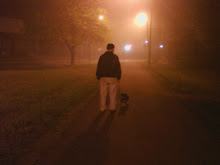
Having internet connection problems at home. Blogging is not much fun when those issues arise. In the words of that great theologian Charlie Brown, "Aaaugh!"
Still With Faith and With Feathers,
David
Friday, October 22, 2010

Saturday, October 16, 2010
Weaving New Life
If anyone is in Christ, there is a new creation. II Corinthians 5:17
It has been awhile since my last post in part because of a busy schedule – travel to Nashville for six days for two United Methodist meetings, and in part because of internet problems at home. I arrived back home earlier this week to find that television service had been lost – missed the Vikings game on Monday (as did the Vikings themselves in the first half), and then once that was repaired to have sporadic outages in our internet even after replacing the modem and router. Anyway, on to other thoughts – thoughts conceived on a hotel treadmill and jotted down on paper in airports.
There is a type, probably no person fits it perfectly, but a type - - - the person who inside never graduates from high school. There is the athlete whose best time in life was sinking the winning basket, scoring the winning goal, throwing the winning pass. There is the homecoming queen who has never felt as adored since. There is the A student never again able to replicate her or his success.
High school for me was a mixed bag. I look back with a certain fondness, but also recall the pain, awkwardness, disappointment. Perhaps this is a type, too, one who too easily looks askance at those who hold too closely to high school.
In reality we all weave and weave again our past experiences into our present reality. A healthy weaving allows us to appreciate the past but live in the present, neither holding on to the past too tightly or rejecting it too severely. New life, even in Christ, is a new weaving, not simply a letting go, and the work of the Spirit is toward creativity and freedom as we do our weaving.
I thought of all of this on a treadmill in Nashville. While at meetings, I was on the treadmill every night and one night this fascinating sequence of songs shuffled through my ipod:
Dan Fogelberg, “Same Old Lang Syne” – song about running into an old class mate –
“felt that old familiar pain”
The Eagles, “I Can’t Tell You Why” – song about love fading away, popular when I was
in high school/college, great slow dance song if you could find a partner
Hall and Oates, “Sara Smile” – enormously popular song in high school, I could
almost feel myself driving wearing my letter jacket on a crisp fall day
Lou Reed, “Coney Island Baby” – the glory of love and playing football for the coach
Herb Alpert, “A Taste of Honey” – a song I remember from childhood. My dad had
this record with a rather unforgettable cover.
And so we live, weaving and reweaving our past – joys and sorrows, desires, dreams, disappointments, accomplishments. Newness of life is a new weaving made possible by a Spirit of creativity and love.
With Faith and With Feathers,
David
Saturday, October 2, 2010
18%
In the September 17 issue of the Duluth newspaper, the News Tribune, there was an article about a recent survey conducted of Americans (Associated Press National Constitution Center). “Glum and mistrusting, a majority of Americans today are very confident in – nobody.” When asked about their trust in people running major institutions, 43% said they are extremely or very confident in the military. That tops the list. 39% expressed confidence in small or local business leaders; the scientific community came in at 30%, and next, at 18% organized religion.
That religion is in the top four should bring a modicum of comfort to those of us whose lives are deeply intertwined with organized religion. That the figure is 18% is a bit disheartening. There are many reasons for this, I am sure. Scandals surrounding Roman Catholic priests and other prominent clergy have been reported regularly in recent years. The face of organized religion is sometimes the face of a pastor of a small church who suddenly becomes famous because he plans a Quran burning (and I am pleased he changed his mind). A few Christians can be seen carrying signs that read: “God hates fags” or “Jesus hates sin.” Most of these actions are not the kind that promote confidence in organized religion.
When I read these numbers again, however, I wonder if there is another factor also involved. I notice that the scientific community rates higher than organized religion in evoking confidence. There is little question that scientific discoveries have enhanced our lives. We need to think only of the dramatic advancements in medical technologies to be grateful for the work of scientists. Perhaps one factor that erodes confidence in organized religion is the way some forms of faith have publically battled science. They have tried to substitute poetic bible passages for scientific literature and in the process give the impression that people of faith cannot contend in an intellectually sophisticated manner with the work of scientists. The most blatant example is the insistence of some in the Christian faith community on reading the first chapters of Genesis as science rather than as theological poetry. To do that is both to misread the Scriptures and to create a false battle against scientific work that helps us understand the processes by which life emerges and changes. If we read Genesis as significant theological poetry that grapples with existential questions about the meaning of life in relationship to God, then there is no tension between it and most scientific work on evolution.
This is not to give science a free pass on all its work. Science cannot answer some of our most basic questions, and some scientists reach too far in some of their statements. To claim that evolution proves there is no God is to go beyond science just as to claim that Genesis is science is to misunderstand the nature of Scripture. Furthermore it is important to remember that a scientific description of hormonal changes, blood vessel changes, heart rate changes is not the same as the human experience of being in love. Science worth its salt is open to data of all kinds, including the data of human experience which does not seem adequately captured by the biology of the brain. And some of the data of human experience is poetic, literary, religious. And again we are aware of scientists so narrowly focused on a particular study that they miss the moral implications of their work.
Perhaps if we in organized religion were willing to have some of these kinds of conversations, the confidence level generated might rise. I kind of hope so.
With Faith and With Feathers,
David
Saturday, September 25, 2010
Don't Call Them Twinkies | The Current Music Blog | The Current from Minnesota Public Radio
The lead singer of one of my favorite bands this summer, The Hold Steady, singing about Minnesota Twins baseball. Heaven is whenever... (play on Hold Steady album title!)
Don't Call Them Twinkies | The Current Music Blog | The Current from Minnesota Public Radio
Monday, September 20, 2010
Brief Thoughts on a Short Story
One joy of the short story is that even when life is busy, a story might be read that captures something of the wonder, beauty, mystery of life, crystalizing it into a small gem. Last night before going to sleep, I read William Maxwell’s story “What He Was Like.” In a few pages Maxwell evokes the wonder and mystery of the inner life. The plot is simple enough, a man keeping a diary, his death, his daughter’s reading of his diary and wondering why she did not know so much about her father, her dismay at his interior life.
Here are a couple of excerpts from the diary as noted in the story: “If I had my life to live over again – but one doesn’t. One goes forward instead, dragging a cart piled with lost opportunities.” “To be able to do in your mind what it is probably not a good idea to do in actuality is a convenience not always sufficiently appreciated.”
Our lives are what we do, but also what we think, dream, imagine, appreciate. Maxwell’s story reminded me of that again.
With Faith and With Feathers,
David
Friday, September 10, 2010
Why I Continue to Read the Bible
Why I Continue To Read the Bible
Sometimes because I think I have to;
Sometimes because I think I should;
Mostly for those times when the words
are like a gentle rain for
the parched field of my soul,
the familiar voice of a friend
in a time of deep loneliness,
an axe
for the frozen sea inside (Kafka).
For times like the other day
But I have calmed and quieted my soul,
like a weaned child with its mother;
my soul is like the weaned child that is with me.
(Psalm 131:2)
With Faith and With Feathers,
David
Friday, September 3, 2010
Autumn Nostalgia
Today felt like autumn here in Duluth. It was rainy and temperatures struggled to get into the low 60s. Autumn often brings with it nostalgic feelings. School begins in the fall, and I love learning. I spent twenty-seven of my fifty-one years preparing for school in one form or another in the fall of the year.
I have been thinking about my childhood as I read Josh Wilker’s memoir Cardboard Gods. Wilker tells his story with the aid of baseball cards from his childhood collection (I collected baseball cards and tonight before their game the Twins introduced the top fifty Twins from their fifty years ). I have also been thinking about my childhood this week as I have been preparing to officiate at the funeral of a young woman (forty-six) who grew up in the same neighborhood as I did. Meeting with her family has brought back a number of memories.
In his book, Wilker writes the following: You can’t be a child forever. You have to slice that part of yourself away and put on a uniform of some sort, whether it’s official or unofficial, and punch that clock. Is there a way to do this and still hang on to a wider sense of the world?
Wilker poses a great question. Can we hang on to a wider sense of the world? Can we retain some of the sense of wonder that we have as children? Can we keep something of what seems an almost innate sense of compassion in children?
Perhaps one way we carry with us some of the positive qualities of childhood is to nurture a healthy nostalgia. By a healthy nostalgia I mean revisiting the past not to hold it up as an ideal now unachievable, but to cultivate some of the important feelings, attitudes and moral sentiments that may have been present. Such healthy nostalgia can come with a wistfulness and sense of loss, but those should not overshadow the cultivation of moral sentiments.
I think there may be something here. Didn’t Jesus encourage the cultivation of certain aspects of childhood?
Not long ago, I encountered another literary exploration of the past, one set in autumn. The sense of loss is palpable. Nevertheless it permitted me to think about my past in a different way - another aid to a healthy nostalgia.
Now I peek into windows and open doors and do not find that air of permission. It has fled the world. Girls walk by me carrying their invisible bouquets from fields still steeped in grace, and I look up in the manner of one who follows with his eyes the passage of a hearse, and remembers what pierces him. John Updike, “In Football Season”
With Faith and With Feathers,
David
Subscribe to:
Posts (Atom)